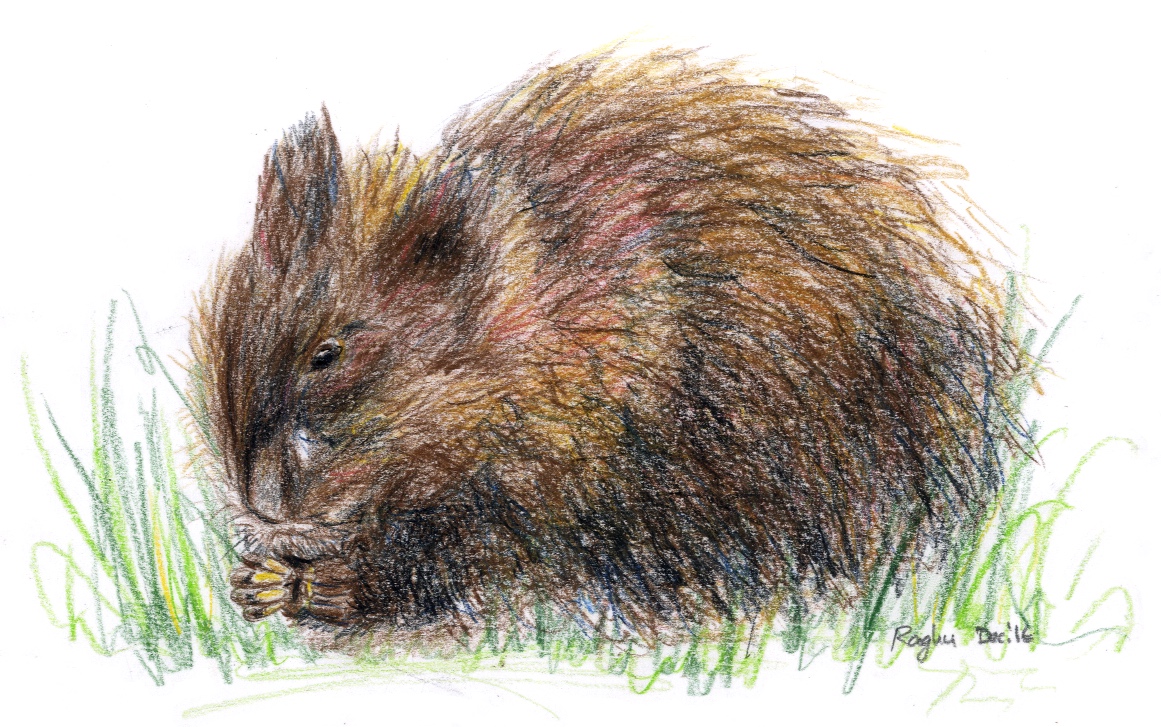
In 1905, a Bohemian landowner imported five muskrats from North America because he liked the fur, and let all five loose in a pond on his estate to breed.1 Within twenty years his five rodents were millions, they'd taken a big chunk of central Europe, and the best part is they spread so evenly it looked rigged: an expanding circle whose edge crept outward by the same number of kilometres every single year.1. J. G. Skellam reconstructed the invasion from trapping records ("Random dispersal in theoretical populations," Biometrika 38, 1951). Plot the square root of the occupied area against time and you get a straight line — the fingerprint of a front moving at constant speed. The animal is Ondatra zibethicus; the release is pinned to the Colloredo-Mansfeld estate near Dobříš. Nobody consulted the muskrats.
A constant speed is suspicious. Nature almost never holds a steady rate — things accelerate, saturate, crash, or wobble. A straight line usually means something very simple is running the show underneath. R. A. Fisher wrote down what in 1937 — about three decades after the muskrats got loose and started proving it without him.
Two ingredients, that's the whole model. Things wander at random — diffusion. And wherever they land they breed, fast at first, then easing off as the place fills up — the logistic term.
∂u/∂t = D · ∂²u/∂x² + r · u(1 − u)
u is just a fraction between 0 and 1: how full a patch is, or — Fisher's actual question — how common a useful gene has got.2 He was doing evolution, not rodents. The muskrats didn't read the paper but happened to obey the same equation.2. "The wave of advance of advantageous genes," Annals of Eugenics 7 (1937), 355–369. Yes, that was the actual name of the journal. We'll come back to it.
§01What the figure shows
A travelling wave is a shape that moves without ever changing shape. Behind it the new thing has won (u → 1); ahead of it the old world carries on, oblivious (u → 0); the join between them just slides. The only real question sounds dull: how fast?
Irritatingly, there's no single answer — a wave exists for every speed above a minimum, c* = 2√(rD). Then reality hands you one anyway. Start from a localised clump — invaders dumped on an empty map, one mutation in one place — and out of every speed it's allowed, the front picks the slowest.3 It could go faster. It doesn't.3. The speed is decided at the leading edge, where u is tiny and u(1 − u) ≈ ru. There the equation goes linear — ut = D·uxx + ru — and that linear tip travels at exactly 2√(rD). The crowded bulk behind it just keeps up. Fronts like this, where the sparse tip does the work and drags the rest along, are actually called "pulled."
So the whole result is c* = 2√(rD). Quadruple the growth rate and the wave only doubles — the square root gives with one hand and takes with the other. Same story for diffusion. In the figure, turning r up speeds the front and sharpens it at the same time, because the speed (2√(rD)) and the front's width (~√(D/r)) are hostage to the same two numbers.
double D → c* ×1.41
the tip, where u≈0, sets the pace
// pullThe same operator Turing used last month to grow a pattern out of nothing, Fisher used to shove one across a continent.
Skellam's muskrats are just this in two dimensions: the radius grows at c*, so √area comes out linear, so his plot is a straight line. The same shape turns up anywhere something breeds and spreads — Neolithic farming crawling across Europe at about a kilometre a year, tumours pushing into tissue, the leading edge of a fire.4 Cheerful list.4. Ammerman & Cavalli-Sforza clocked the farming "wave of advance" at ~1 km/year (Man 6, 1971) — slow enough that it reads as people migrating, not the idea of farming outrunning the farmers. And a flame front is a reaction-diffusion wave for real: heat diffuses, fuel reacts.
§02For R. A. Fisher
You can't write about Fisher without a "but," so here it is early. He co-founded population genetics and more or less built modern statistics single-handed — every ANOVA, every maximum-likelihood anything, that's him. He also edited a journal called the Annals of Eugenics and published there on purpose, and his enthusiasm for eugenics was not some passing quirk of the era. I'm not going to tidy that into a footnote.55. The same year, three Moscow mathematicians — Kolmogorov, Petrovsky and Piskunov — wrote down the same equation independently and did the bit Fisher skipped: they proved localised starts converge to the minimum-speed wave. Fisher's version was a very good hunch. So it's Fisher–KPP — four names, one wave. Kolmogorov had already axiomatised probability itself a few years earlier (1933), because apparently one field wasn't enough.
This is a very cheap result. No fitted parameters, no simulation, no cluster — two things every living thing already does, spreading and breeding, producing a number you can check with a map and a calendar.
Fisher died on 29 July 1962 in Adelaide, about as far from Cambridge as you can get without a boat and real commitment. The wave still carries his name — plus, in fairness, three he never met.
— written in July, at a desk the muskrats have so far declined to reach.